

Why Mooring Gear Deserves a Closer Look
Mooring a boat in exposed water is a quiet act of trust. You head home, the tide turns, the wind backs round to the south-west and builds through the night, and everything you own is held by a handful of metal fittings and a length of rope you last looked at in June sunshine. Most of the time it holds beautifully. Occasionally it does not, and the morning brings a boat on the rocks or a neighbour's bowsprit through your pulpit.
The good news is that the failures are almost never sudden. Shackles wear oval, swivels seize, line chafes on a fairlead, a riser chain thins inside a link where you cannot see it. Check your gear before the gales arrive and you will catch nearly all of it in time.
Shackles and Swivels: The Small Parts That Matter Most
Shackles are cheap. Boats are not. Treat every shackle in the mooring as a consumable and inspect them with a suspicious eye.
- Look for ovality. A shackle that has been working under load will stretch and its pin or bow will no longer sit true. If a pin drops through without resistance, it is worn.
- Check for corrosion. Galvanised shackles go dull grey and gritty, which is fine. White or grey powder on stainless, or a pinkish tinge on galvanised steel, means trouble.
- Mouse every pin. A stainless wire mouse, a heavy cable tie or a seized turn of monel wire stops the pin backing out as the boat swings. Never rely on hand-tight alone.
- Inspect the swivel. A tired swivel that no longer turns transfers the boat's rotation into the riser, and the twist has to go somewhere. If it does not spin freely by hand, replace it.
- Match metals sensibly. Mixing stainless shackles with galvanised chain in salt water invites galvanic corrosion. Keep the materials consistent through each connection.
Ropes, Warps and Strops
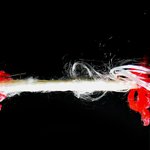
Rope is generous and forgiving, right up to the moment it is not. Chafe, not breaking strain, causes most mooring line failures.
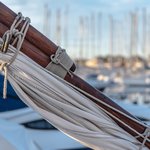
Run your hand along the full length of every line, not just the parts you can see from the cockpit. UV damage stiffens and bleaches the outer fibres; a rope that has gone hard and pale has lost much of its strength. Look especially at the splice, the thimble and anywhere the line passes through a fairlead, over a toe rail or across a mooring cleat. Chafe is often hidden where the line bears on the same spot every tide.
- Prefer spliced eyes with a thimble to knotted ends. Knots reduce strength substantially and work loose under cyclic load.
- Fit chafe guards or a length of sacrificial tube wherever a line crosses a hard edge, and check they have not slid out of place.
- Use nylon for shock absorption where there is fetch and surge, and polyester where you want low stretch and minimal creep. Nylon stretches and recovers; polyester holds its length and resists UV a little better.
- Keep a pickup line slack enough to reach from deck at any state of tide, but not so long that it can wrap the riser or the propeller.
Buoys, Sinkers and the Riser
The buoy has one job: to keep the riser off the seabed and available when you return. If it sits low in the water, it is waterlogged and giving you nothing but drag. Foam-filled buoys eventually absorb water through a crack; hard-shell types can flood through a failed seam. Weigh it, or simply watch it in a chop. A buoy that ducks under in a modest swell wants replacing.
The riser itself deserves an annual haul out. Chain wears at the interlink and at the point where it meets the sinker, and the last two links above the ground tackle are often the thinnest. If any link is visibly reduced or the galvanising has gone entirely, cut out the worn section and re-shackle, or replace the riser. A ground chain that has lost its coating will corrode faster from then on.
A Simple Seasonal Routine
You do not need a team of riggers. You need twenty minutes, a pair of gloves and a habit of looking properly.
- Before the season: haul the riser if you can, inspect every shackle and swivel, replace any line showing hard or faded fibres, and renew mousing wire.
- Monthly through the season: take the dinghy round, check the buoy rides correctly, glance at the pickup line and confirm nothing has wrapped.
- After every gale: walk the deck and the lines. Strong winds find the weakness you missed, and one good blow can chafe a season's worth of wear into a single night.
- Note the dates. Write replacement dates on the gear with a paint pen. Memory is unreliable; paint is not.
Replace Early, Sleep Better
The instinct to nurse another season out of a tired shackle or a frayed strop is understandable, and it is the single most common reason boats come adrift. Compared with a lift-out, a repair or an insurance excess, new stainless and a fresh length of nylon are trivial. Buy the good gear, fit it properly, mouse the pins and swap it out before it fails rather than after.
Do that and your mooring becomes what it should be: a quiet, dependable arrangement that holds through the tide, the swell and the long dark nights when you are not there to watch it.




John Doe
14 January, 2022Having no content in post should have adverse..
Chauffina Carr
10 April, 2022We use these tests all time! Killer stuff!
Jim Séchen
16 July, 2022Thanks for all the comments, everyone!